AI Search Is Still Search. Seeing It Is the Hard Part.
We checked 13 popular AI search tactics against platform docs and published studies. Three hold up, three have no support, and measurement is the bigger gap.
The short answer
As of October 30, 2026, the evidence points one way. AI answer engines pull from search indexes and reward what search has rewarded for years: pages a crawler can read, content nobody else has, and a reputation that exists beyond your own site. Several AI-specific tricks, like llms.txt files and schema added to earn citations, have no measured effect on whether you get cited. Most of the rest help only as far as they make a page easier for people to read.
What changed is harder to see. Fewer people click. Many of the ones who do arrive from an AI answer show up with no referrer, so analytics files them under “direct.” If you judge AI search by the AI referral line in your dashboard, you are looking at a floor, not the total.
What the platforms actually say
Google put its position in writing. Its guide to generative AI features in Search says “optimizing for generative AI search is optimizing for the search experience, and thus still SEO.” The same guide says an llms.txt file “will neither harm nor help” a site’s visibility in Google Search, that “there’s no requirement to break your content into tiny pieces,” and that “there’s no special schema.org markup you need to add.”
Google also draws a line between commodity and non-commodity content. Its example of commodity content is “7 Tips for First-Time Homebuyers.” Its example of the other kind is “Why We Waived the Inspection & Saved Money: A Look Inside the Sewer Line,” a first-hand account nobody else could write.
Microsoft is more prescriptive. Its October 2025 guidance on getting content into AI search answers recommends clear headings, lists, tables, Q&A formats and schema, and warns that AI systems may not render content hidden in tabs or expandable menus. The two companies disagree on structure and schema. They agree that a crawler has to be able to read the page.
OpenAI and Anthropic each run separate crawlers for model training, search, and fetches a user asks for. OpenAI’s documentation says sites that block its OAI-SearchBot “will not be shown in ChatGPT search answers.” That robots.txt decision has a clear, documented cost.
13 tactics, checked against the evidence
These tactics show up again and again in “AI-first website” checklists this year.
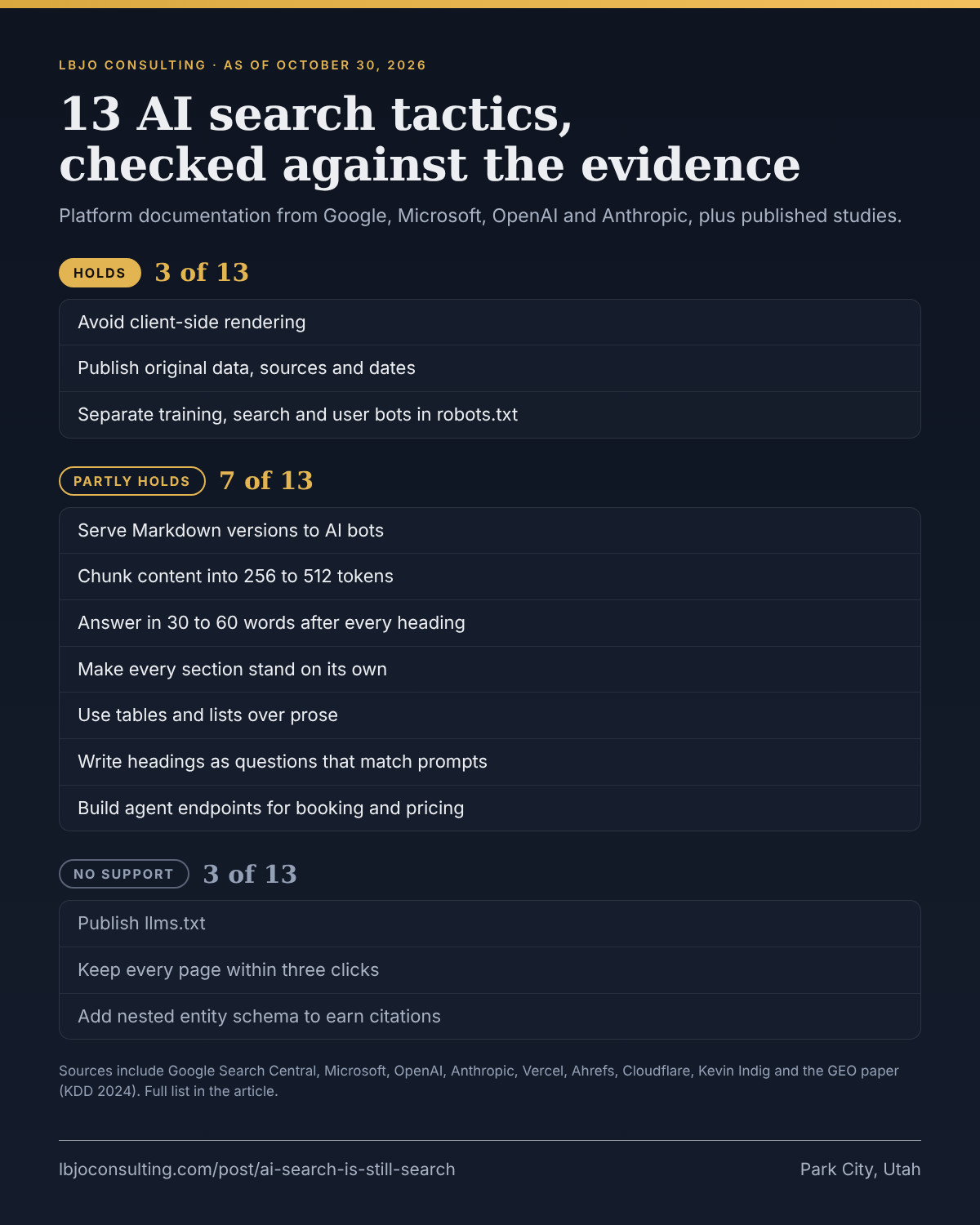
| # | Tactic | Verdict | What the evidence shows |
|---|---|---|---|
| 1 | Publish llms.txt and llms-full.txt | Unsupported | Google says the file neither helps nor harms. Google’s John Mueller wrote in June 2025 that, at the time, “no AI system currently uses llms.txt.” Ahrefs found 97% of about 38,000 published llms.txt files got zero traffic in May 2026. |
| 2 | Serve Markdown versions to AI bots | Partly holds | Cloudflare converts pages to Markdown when a request asks for it, and says Claude Code and OpenCode already ask. Those are coding agents, not the search crawlers behind citations. Showing bots different content than people see is a cloaking risk. |
| 3 | Avoid client-side rendering | Holds | Vercel’s server-log research found “none of the major AI crawlers currently render JavaScript.” Googlebot and Applebot do. If your key content needs JavaScript to appear, most AI crawlers never see it. |
| 4 | Keep every page within three clicks | Unsupported | No platform or dataset ties click depth to AI citations. Crawlers find URLs through indexes, sitemaps and links. Ordinary internal linking still applies. |
| 5 | Chunk content into 256 to 512 tokens | Partly holds | Engines retrieve passages, not whole pages. No consumer AI search product publishes a chunk size, and Google says chunking isn’t required. |
| 6 | Answer in 30 to 60 words after every heading | Partly holds | Kevin Indig’s analysis of 18,012 ChatGPT citations found 44.2% came from the first 30% of a page. That is a correlation, for one engine. The 30 to 60 word rule has no primary source. Leading with the answer is good writing anyway. |
| 7 | Make every section stand on its own | Partly holds | Fits Microsoft’s guidance and passage-level retrieval. No controlled study tests it. |
| 8 | Use tables and lists over prose | Partly holds | Microsoft recommends them. Google says to organize pages for readers. Breaking everything into fragments hurts the people reading. |
| 9 | Write headings as questions that match prompts | Partly holds | Clear headings help. Google says it understands synonyms, so mirroring every prompt variant is wasted work. |
| 10 | Add nested entity schema to earn citations | Unsupported | In Ahrefs’ controlled test, 1,885 pages added schema against 4,000 matched controls. Citations moved 2.4% in AI Mode and 2.2% in ChatGPT, neither meaningfully different from zero, and fell 4.6% in AI Overviews. Basic Organization and Article schema still earn rich results. |
| 11 | Publish original data, sources and dates | Holds | Google prioritizes first-hand, non-commodity content. Ahrefs found AI assistants cite content 25.7% fresher than Google’s organic results. In a lab benchmark, the GEO paper (Aggarwal et al., KDD 2024) found that adding citations, quotations and statistics raised visibility by up to 40%. |
| 12 | Separate training, search and user bots in robots.txt | Holds | OpenAI and Anthropic document a separate crawler for each job. Blocking the search crawler removes you from that engine’s answers. Allowing training is a business decision. |
| 13 | Build agent endpoints for booking and pricing | Partly holds | The standards for agents to book and buy are still being built. Worth a pilot for ecommerce and booking-heavy businesses. Early for most services firms. |
Where citations come from
Answer engines lean on a short list of third-party sites. Profound’s study of 680 million citations, from August 2024 to June 2025, found Wikipedia made up 7.8% of all ChatGPT citations. Reddit made up 6.6% of Perplexity’s citations and 2.2% of Google AI Overviews’.
That mix moves fast. Reddit averaged 3.83% of ChatGPT Search citations from July 18 to August 7, 2026, fell below 1% by August 14, and averaged 0.52% after that, per Promptwatch data reported by Axios. Promptwatch called the size of the drop provisional. A plan built around one engine’s favorite source this quarter can break next quarter.
The part that holds across engines: you need to exist in places other than your own site. For a B2B firm, my starting list is named people at your company writing on LinkedIn, podcast appearances, contributed articles, directory and review profiles, and a spot in the lists buyers already read.
The click gap
Fewer searches turn into visits.
- Seer Interactive (3,119 informational search terms, 42 organizations): organic click-through rate on queries with an AI Overview fell from 1.76% in June 2024 to 0.61% in September 2025, down 61%.
- Pew Research (900 U.S. adults, March 2025): people clicked a traditional result on 8% of visits that showed an AI summary, vs 15% of visits without one. About 1% clicked a link inside the summary.
- Ahrefs (300,000 keywords, December 2025): an AI Overview correlates with a 58% lower average click-through rate for the top-ranking page.
Cited brands got slightly more clicks. In Seer’s data, brands cited inside the AI Overview had a 0.70% organic click-through rate, vs 0.52% when they were not cited. Seer notes that this does not prove the citation caused the difference.
Why your analytics miss most of it
This is the part I care about most, because I have fought it before. When I joined Linqto, more than 80% of conversions reported as “direct.” At that scale, “direct” means stripped referrers, untagged links, dark social, and redirects dropping data on the way in. Rebuilding attribution cut unattributed “direct” traffic to under 30%. The full case study covers how.
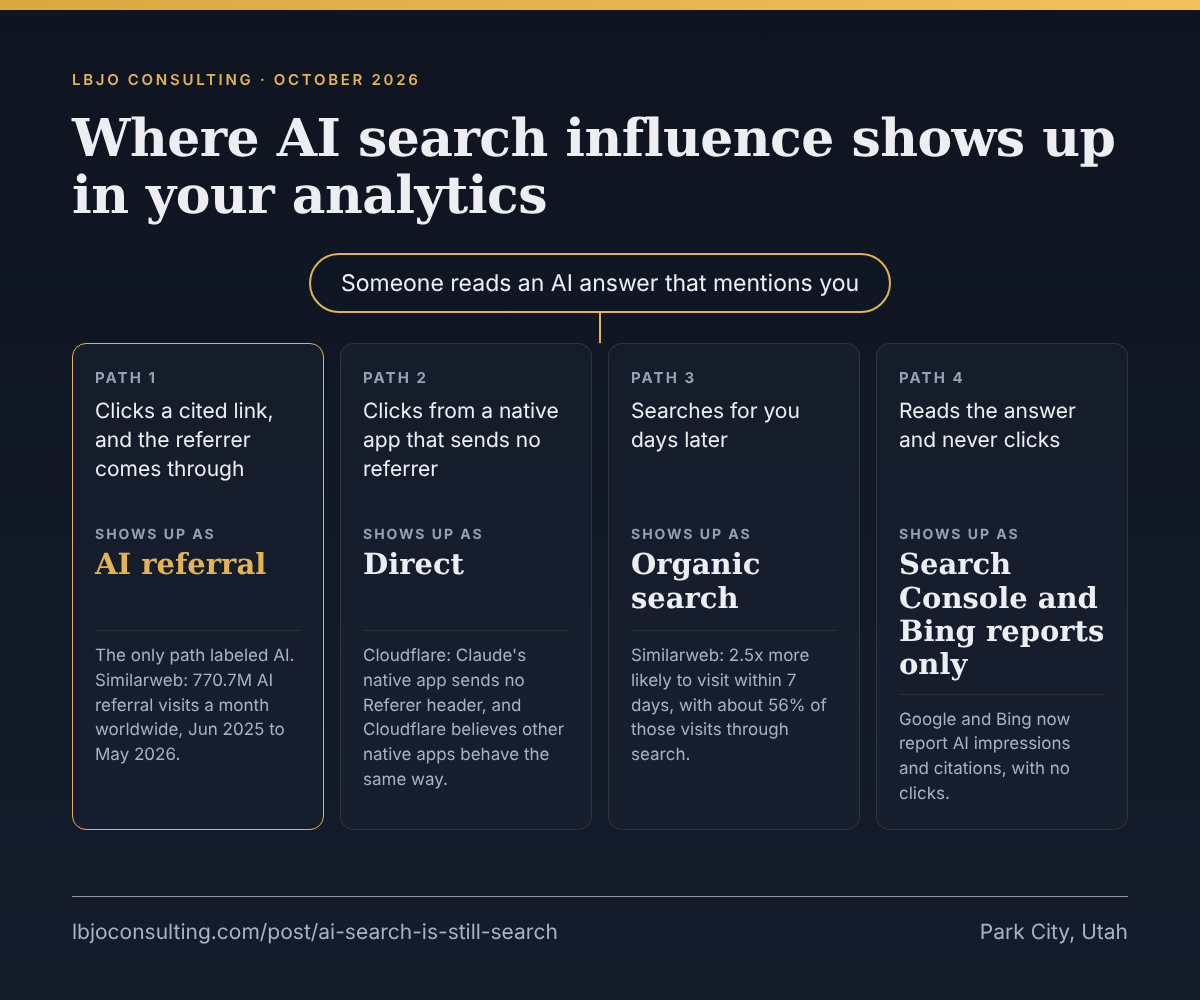
AI search feeds that same bucket in three ways.
- Visits with no referrer. Cloudflare found that traffic from Claude’s native app carries no Referer header, and believes the same holds for other native apps. Similarweb confirms that visits without a referrer go into direct traffic.
- Visits that come later, through search. Similarweb found people who got a brand recommendation from an AI assistant were 2.5 times more likely to visit that brand’s site within seven days. Search accounted for about 56% of those visits, vs about 40% of typical visits. Someone who reads about you in an AI answer on Tuesday and searches your name on Friday shows up as organic search.
- Impressions with no click. Google’s Search Console report for generative AI features shows impressions in AI Overviews and AI Mode, with no clicks. Bing Webmaster Tools’ AI Performance report shows citations and a sample of grounding queries, also without clicks.
So treat the AI referral line in your dashboard as a floor. Similarweb counted an average of 770.7 million AI referral visits a month worldwide from June 2025 to May 2026, up 117.4% from the year before. Visits without a referrer fall outside that count, so it can only miss AI traffic, never add to it.
What to measure instead
- Search Console and Bing AI reports, monthly, by page. They are the only first-party view of AI impressions and citations.
- AI referrers as their own channel: chatgpt.com, perplexity.ai, claude.ai, gemini.google.com and copilot.microsoft.com, grouped so they stop hiding under “referral.”
- Branded search over time, from Search Console. Recommendations made inside AI answers tend to show up here.
- A “How did you hear about us?” field on every form and booking flow, with AI assistants as an option.
- UTM tags on every link you control. At Linqto the largest single contributor to “direct” turned out to be our own untagged links coming home. Fix that first, and the rest of the bucket gets small enough to reason about.
What we did on this site
lbjoconsulting.com is a static site: every page is plain HTML on the first request, with nothing important behind JavaScript. Our robots.txt allows search, user and training crawlers on purpose. We verified the site in Google Search Console and Bing Webmaster Tools on October 18, 2026, submitted the sitemap to both, and sent every URL to IndexNow. We keep an llms.txt file as a cheap hedge, knowing Google says it neither helps nor harms in Search.
That setup is twelve days old as I write this, so there is no data worth sharing yet. We will update this piece in late January 2027 with what Search Console, Bing and our own referrer data show after 90 days.
What I would do this quarter
Do now
- Check robots.txt and your CDN’s bot settings together. Cloudflare’s managed robots.txt can add blocks above your own rules, so read the live file, not the one in your repo.
- Fetch your key pages without JavaScript and confirm the content is in the HTML.
- Verify Search Console and Bing Webmaster Tools, and start reviewing the AI reports monthly.
- Shrink your “direct” bucket before you judge any channel, AI included.
- Publish one thing only you can: a case study with real numbers, your own benchmark, or a decision you made and why.
Cheap hedges
- Basic Organization, Person and Article schema, for rich results.
- An llms.txt file. It costs little, and Google says it neither helps nor harms.
- A fixed set of prompts you check monthly in the engines your buyers use, read as a trend rather than a measurement.
Skip
- Separate pages for every way someone might phrase a query. Google’s guide says doing that to manipulate rankings or AI responses violates its scaled content abuse policy.
- Bot-only versions of your pages.
- Buying or faking mentions. Google’s guide says “seeking inauthentic ‘mentions’ across the web isn’t as helpful as it might seem.”
If you want this applied to your site, our AI search visibility audit covers crawler access, measurement, and the content and off-site gaps, in that order.
Changelog
- October 30, 2026: First published. Next scheduled update: late January 2027, with 90 days of this site’s own Search Console and Bing data.
Sources
- Google Search Central, “Optimizing your website for generative AI features on Google Search” (last updated July 10, 2026): the “still SEO” position, llms.txt, chunking and schema guidance, commodity content examples, scaled content abuse and inauthentic mentions. developers.google.com
- Microsoft Advertising blog, “Optimizing Your Content for Inclusion in AI Search Answers” (October 8, 2025): structure, schema, and the warning about hidden content. about.ads.microsoft.com
- OpenAI, “Overview of OpenAI Crawlers”: OAI-SearchBot, GPTBot, ChatGPT-User. developers.openai.com
- Anthropic help center, crawler documentation (updated April 7, 2026): ClaudeBot, Claude-SearchBot, Claude-User. support.claude.com
- John Mueller on Bluesky (June 17, 2025): “no AI system currently uses llms.txt.” bsky.app
- Ahrefs llms.txt study (June 15, 2026): 97% of about 38,000 files got zero traffic in May 2026. ahrefs.com
- Cloudflare, “Markdown for Agents” (February 12, 2026): Markdown conversion and the agents that request it. blog.cloudflare.com
- Vercel, “The rise of the AI crawler” (December 17, 2024): AI crawlers and JavaScript rendering. vercel.com
- Kevin Indig in Search Engine Journal (February 17, 2026): 44.2% of 18,012 ChatGPT citations from the first 30% of text. searchenginejournal.com
- Ahrefs schema test (May 11, 2026): 1,885 test pages vs 4,000 controls. ahrefs.com
- Ahrefs freshness study (July 28, 2025): AI assistants cite content 25.7% fresher than organic results. ahrefs.com
- Aggarwal et al., “GEO: Generative Engine Optimization” (KDD 2024): up to 40% visibility gains in a lab benchmark. arxiv.org
- Profound, “AI Platform Citation Patterns” (June 2025, updated August 2025): Wikipedia and Reddit citation shares across 680 million citations. tryprofound.com
- Axios (August 20, 2026): Promptwatch data on Reddit’s share of ChatGPT Search citations. axios.com
- Seer Interactive (November 4, 2025): AI Overview click-through rates through September 2025. seerinteractive.com
- Pew Research Center (July 22, 2025): clicks with and without AI summaries. pewresearch.org
- Ahrefs (February 4, 2026): AI Overviews and top-ranking page click-through rate. ahrefs.com
- Cloudflare (July 1, 2025): native app traffic without a Referer header. blog.cloudflare.com
- Similarweb (June 23, 2026): AI recommendations and brand visits within seven days. aisearch.similarweb.com
- Similarweb (September 3, 2026): 770.7 million AI referral visits a month, and no-referrer visits counted as direct. aisearch.similarweb.com
- Google Search Central blog (June 3, 2026): generative AI performance reports in Search Console. developers.google.com
- Bing Webmaster blog (February 10, 2026): AI Performance in Bing Webmaster Tools. blogs.bing.com
Want this thinking applied to your business? Schedule a free consultation or see the services.